For the last several decades, the discussion in and around architecture[1] has been driven solely, almost pathologically, by the image of the object. Post-modernist, deconstructionist and now proponents of “folding” architecture, despite their occasional claims to critical or philosophical foundations, all have been primarily, if not exclusively, concerned with the aesthetic form of the objects produced. And while it is true that architecture is a visual art with highly functional requirements – requirements that are often at war with its desire to be “art for art’s sake” – the dominance of the image as the “end-all-and-be-all” of architecture has for some been both overdertermined and detrimental. Overdetermined, because rightly or wrongly it allows architecture to be seen as the privy of the culturally privileged – a distant and esoteric profession that has little, if anything, to do with the way in which most people live their lives. Detrimental, because the insistence on the primacy of the aesthetic positions the architect as little more than a self-absorbed artist, busily pursuing a tortured vision of art, concerned only with the creation of their individual, autonomous work. However seductive that situation above may be for the individual designer, for the profession of architecture it is an untenable combination, as establishing architects as simply aesthetic experts only ultimately divest them from a professional responsibility to the public.
More than any other moment in recent history, architects are freer – theoretically, at least – to pursue design as personal ideology, as the outline of what an architect does is increasingly weighted more towards an artistic interpretation of practice and less a professional one. If left unaddressed, it is easy to envision that eventually the architect will become purely a provider of design expertise and even then, only for those who can afford it – inconsistent with both the historical role, and more important, the significance, of the professional in society:
[Historically], what architects created was linked, in the public mind, to broad social, political, and moral goals…[but now] other than giving the owner of a building a slight marketing edge, architectural aesthetics – which we still view as central to our profession – has little value in people’s perception.[2]
Concept
Concerned by what the contributors see as the marginalization of architecture’s value in the civic realm, Activist Architecture presents a unique set of essays, images and practical models that situate visible ethics alongside visual aesthetics as an essential disciplinary contribution to civil society. At the center of this effort is our concurrence with the assertion by Tom Fisher, Dean of the University of Minnesota College of Design and former editor of Progressive Architecture that “[e]very profession is a public trust, charged with addressing public problems.”[3] Architecture – along with the medicine and law – is commonly considered to be one of the first established professions.[4] And while both medicine and law have made clear their belief in the practice of their profession as a public trust – so much so that they have developed institutional systems that both fulfill their professional obligations and instill in their members a sense of importance about that obligation – architecture has been slow to follow suit.
The practice of architecture has become a self-referential, isolated, almost selfish act, due in large part to its inattention to its public duty; for some considerable time, its had to be accountable to nothing but itself. However…what if architecture were to follow the lead of the legal and medical professions and develop a similar social sensibility and call to duty beyond the immediate, personal concerns of its members? What if it were to take the position that it won’t wait for problems of/in the environment to be presented for solution but would actively identify issues and address them? What, then, might the field of architecture look like to both its members and the public? Our volume engages these and many other critical questions about the relationship between the profession of architecture and the public that authorizes it. We address the profession’s lack of both a recognizable ethical claim and institutional infrastructure and propose that the recent rise in the establishment of community design centers across the country is an answer to both. It is a rise that hasn’t gone unnoticed. Robert Ivy, editor of Architecture Record wrote:
Something’s in the air. Call it community-based design. Call it architecture for people. In any understanding, socially conscious architecture seems to be blossoming again.[5]
Rooted in the ideological foundation that everyone regardless of race, gender or class should have access to the expertise of architects, community design is an architectural paradigm devised to respond to the criticism that the profession has indeed forgotten its duty to the public and the community design center is the primary infrastructure that facilitates the profession’s response. At their heart, community design centers are critical practices that intentionally open up and address questions of social responsibility and ethical aesthetics for the profession. Simultaneously traditional and non-traditional – entrepreneurial at their base and expansive in their application, community design centers are the epitome of what we are defining as activist architecture – a way of perceiving, teaching and practicing that derives from, is relevant to, and vigorously engages the community in which the architecture is placed. It is a process of design in which communal sustainability and environmental equity influence the physical growth and economic direction of the built environment; an idea about practice that redefines not only architecture and architect, but also who is actually worthy of the discipline’s enormous gifts/abilities to make their lives better. The recent hurricanes in Texas, Louisiana and new Jersey have offered architects a window of opportunity to apply activist paradigms – and albeit unevenly, to their credit they are doing so – but proponents of community design centers correctly argue that it should not take the catastrophic to see the value to both the profession and society of such efforts. Waiting on these types of events is no way to build neither a position nor a practice. So, how might interested architects go about establishing this type of critical practice? What impact can such a practice have? What questions should it engage?
Activist Architecture provides those answers.
Approach
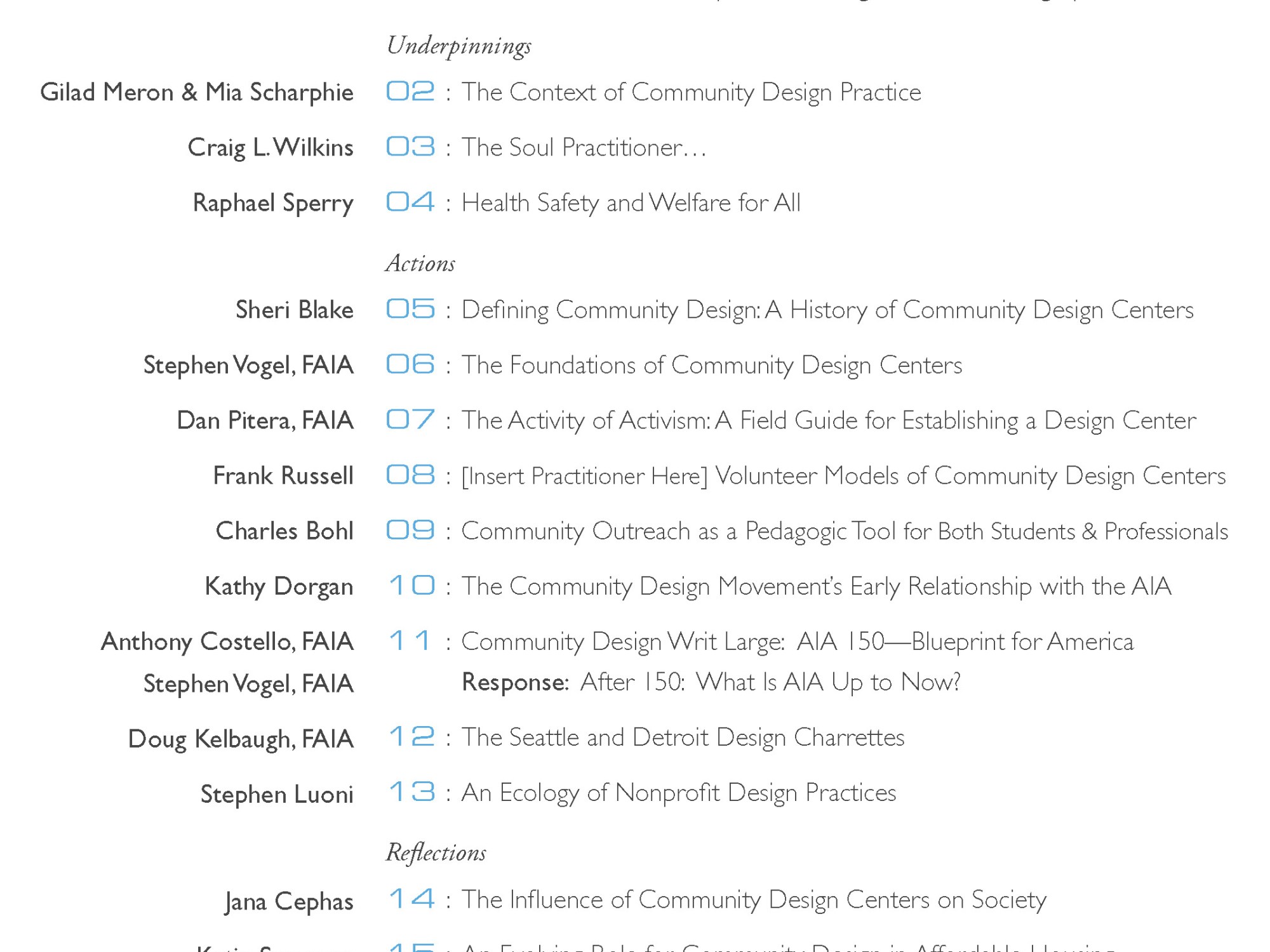
Activist Architecture: Philosophy and Practice of the Community Design Center is the first book to combine the philosophical justification, historical foundation and practical organization, models, projects, and influence of community design centers on the profession, academy and society. Written by some of the most prominent historians, critics, practitioners and theorists in the field today, it is a philosophical, historical and practical guide to establishing, operating and growing a community design center. At a time when society is reevaluating the public role and civic contribution of architects, it is both a “why-to” and “how-to” guide for establishing a community design center in all of its various forms. As such, the essayists in this volume – leading thinkers and practitioners in the area of ethics and aesthetics – and discusses such important issues concerning community design centers as:
- Professional & Ethical – Are community design centers the only place to engage environmental & social justice in the practice of architecture? What are the similarities, differences, collaborations, and conflicts between the professional for-profit firms and the academic non-profit centers? How can one balance the conflict between the professional’s self-interests and their position as champion of the shared public resources in the built environment?
- Practical – How might one conceive and build a critical activist practice in our current educational and professional paradigm? What are the goals and objectives, typical clientele, types of projects and products of community design center models? What types of questions and projects should such a practice engage? What is the influence of community design centers on design and economic development, environmental conservation, sprawl and smart growth, livable communities, open space and regulatory rules that influence the physical design of our buildings and communities?
- Production – Do practices like public charrettes, design workshops and participatory design ultimately elevate or diminish architectural aesthetics? Do the typically lower expectations of projects heavily financed by public dollars influence the application of sound design aesthetics? Can projects with limited budgets produce innovative and aesthetically pleasing architecture? Can “architecture” the verb be as professionally fulfilling and noteworthy as “architecture” the noun?
- Educational – How is the study and practice of architecture made better by the work of community design centers? How is/should the work be received by students, faculty and university administrators? Is the work tenure-worthy? What might an academic curriculum with community design as a fundamental educational objective look like?
Notes:
[1] Garry Stevens. The Favored Circle: The Social Foundations of Architectural Distinction. (Cambridge: MIT Press, 1988). p.2.
When employing the term “architecture” we’re referring to the entire field, which includes not only the artifacts produced, but also “the individuals involved in the construction of [the] artifacts, the immediate social structures within which these individuals are embedded, and the discourses they participate in.”
[2] Thomas Fisher. “Three Models for the Future of Practice.” Reflections on Architectural Practices in the Nineties. William S. Saunders, ed. (New York: Princeton Architectural Press, 1996). p.37.
[3] Ibid.
[4] Barry Wasserman, et. al. Ethics and the Practice of Architecture. (New York: John Wiley and Sons, 2000). p.74.
[5] Robert A. Ivy. “It’s in the Air.” Architecture Record. (May 2005).
 Activist Architecture: The Philosophy & Practice of Community Design Centers